
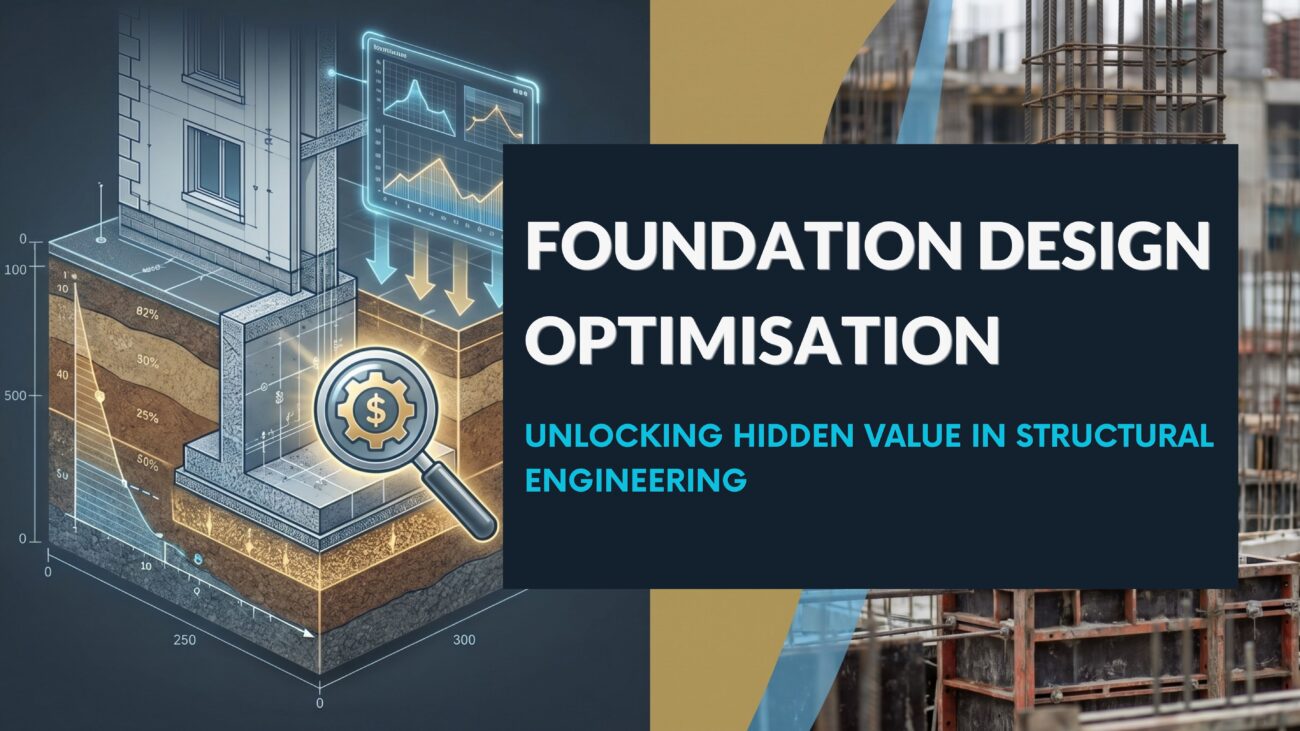
Software for audit and optimisation of foundation design
Inside this guide
This document presents a structured perspective on foundation design audit and optimisation, combining engineering judgement, software-assisted analysis, geotechnical validation and Design.
| Engineering framing | Whether the foundation design and value-engineering logic is technically sound. |
| Software landscape | Whether the named tools are positioned accurately and fairly. |
| Software-assisted workflow | Whether option generation, checking, comparison and auditability are described realistically. |
| Geotechnical interface | Whether soil assumptions and settlement are handled carefully. |
| Market relevance | Whether the positioning is useful for developers, consultants, contractors and proof checkers. |
1. Introduction: The hidden cost beneath every building
The biggest structural decisions often sit below ground.
Every building begins below ground. Before the first column rises, the foundation has already locked in a major part of the project’s structural cost, risk and constructability. Foundation Design Optimisation, the systematic process of evaluating and improving below-ground structural choices, is one of the highest-leverage activities available to any project team.
For decades, foundation design has followed a familiar path: engineers design, proof checkers review, value engineering teams look for savings and contractors execute the approved drawings. This process works, but it is slow, fragmented and dependent on manual judgement.
Today, finite element modelling, geotechnical software and workflow automation, led by software such as OptiFound, are making it possible to audit and improve foundation designs faster than ever before. The opportunity is to help engineers evaluate more safe options before concrete is poured.

2. A brief history of foundations: From stone pads to software-supported option comparison

Foundation engineering is as old as construction itself. Early structures used stone pads, compacted earth, timber piles and masonry bases. As structures became taller and heavier, foundations evolved into engineered systems designed to transfer load safely into soil or rock.
Modern Structural Foundation Design must consider bearing capacity, settlement, eccentricity, uplift, seismic loading, groundwater, excavation constraints and construction sequence. The progression from intuitive masonry bases to software-assisted Design Optimisation mirrors the broader transformation of civil engineering practice.
| Foundation type | Common use |
| Isolated footing | Individual columns on competent soil |
| Combined or strip footing | Closely spaced columns or wall loads |
| Raft or mat foundation | Weak soil, basements and dense column grids |
| Pile or pile-raft foundation | Deep load transfer to stronger strategy |
3. Why RCC foundations became dominant: Concrete, reinforcement and practical constructability
Reinforced cement concrete became the dominant foundation material because it combines compressive strength, tensile reinforcement, durability, mouldability and practical cost efficiency.
RCC foundations can support columns, shear walls, building cores, basements, transfer systems and heavy equipment. They can be shaped as footings, rafts, pile caps, grade beams, pedestals, retaining walls and basement slabs.
Effective Structure Design Optimisation in RCC foundations requires understanding not just the material but also the interaction between geometry, soil stiffness and load distribution. They can be shaped as footings, rafts, pile caps, grade beams, pedestals, retaining walls and basement slabs, each offering a different opportunity for Structural Foundation Design improvement.
4. Proof checking: Essential for safety, but not always designed for option discovery
Proof checking is an independent review of a structural design. The objective is to verify safety, code compliance, design assumptions, calculations, drawings and practical constructability.
| Review area | What is checked |
| Soil interpretation | SBC, settlement criteria, groundwater and strata assumptions |
| Load transfer | Column reactions, load combinations, uplift and lateral effects |
| Stability | Sliding and overturning |
| Structural design | Flexure, one way shear, puching shear, development length |
| Drawings | Detailing, clear cover, lap lengths, notes and construction clarity |
| Constructability | Excavation, sequencing, waterproofing and site constraints |
Traditional proof checking is essential for safety. However, it is usually document-heavy and compliance-focused. It may confirm that a design is safe without deeply exploring whether it is also economical.
Platforms like OptiFound are designed to complement the Structural Audit process by systematically surfacing overdesign and comparing alternatives, turning a compliance review into an optimisation opportunity.
5. Value engineering: Where cost savings begin
Value engineering should not mean unsafe cost cutting. In structural design, good value engineering, and effective Design Optimisation, means achieving the same safety and performance with better use of material, geometry, assumptions, sequencing and detailing.
For foundations, the opportunity lies in comparing viable alternatives, not merely reducing sizes. Engineers can review footing geometry, raft zoning, pile count, pile length, reinforcement rationalisation, tie beam strategy and load-combination assumptions. Audit and optimisation exercises are most impactful when they systematically generate, analyse and compare multiple design options rather than tweaking a single solution.
| Question | Why it matters |
| Is the chosen foundation type suitable for the soil and column grid? | The wrong foundation type can lock in unnecessary cost. |
| Are conservative assumptions repeated across multiple steps? | Small conservatisms can multiply into large material quantities. |
| Are concrete, steel, excavation and construction impacts measured together? | A lower concrete volume may not always mean a lower total project cost. |
| Are alternatives compared under the same design assumptions? | Option comparison must be fair and auditable. |
The strongest optimization workflow is not “make it smaller.” It is “generate, analyse, compare and justify safer alternatives.” The chosen alternative should be Safe and Economical.
6. Why foundations offer high saving potential: Large material quantities plus late-stage change risk
Foundations are highly cost-sensitive because they combine excavation, dewatering, PCC, RCC, reinforcement, shuttering, pile boring, pile testing, waterproofing, backfilling and quality control.
The savings potential from systematic Foundation Design Optimisation becomes larger when soil bearing capacity is low, basements are deep, groundwater is high, column loads are heavy or seismic forces govern.
A safer way to position the claim: Foundations are one of the highest-leverage cost zones in structural design because they use large quantities of concrete and reinforcement and are difficult to modify once construction begins. Additionally, if foundations are underdesigned, implementing corrective measures can be highly challenging and costly. In such situations, engineers often need to adopt conservative strengthening or remediation approaches to ensure the foundation meets safety and performance requirements.
For published cost comparisons, project teams should use actual BOQs, local Schedule of Rates or state rate references where applicable, soil investigation data and contractor quotations. Generic cost claims should be avoided unless they are supported by a named source.
7. Why optimisation often faces less design resistance: Below-ground changes can have fewer cross-discipline conflicts


Above-ground structural changes often affect architecture, facade, interiors, ceiling levels, stairs, fire strategy and MEP coordination. A beam-depth change, column shift or slab-level change can quickly become a multi-discipline negotiation.
Foundation optimization is different. Many exercises happen below ground and can be reviewed mainly between the structural engineer, geotechnical consultant, proof checker and contractor.
This does not make foundation optimisation simple. It still requires design responsibility, soil validation, code compliance and constructability checks. But compared with visible superstructure changes, many foundation optimisation decisions can be evaluated with fewer architectural and MEP dependencies.

8. Where traditional design becomes inefficient: Sequential loops slow down option comparison

Traditional foundation design is often sequential: column reactions are exported, foundation sizes are calculated, reinforcement is designed, drawings are prepared, comments are received and revisions are made.
The inefficiency lies in iteration. If loads, soil parameters, foundation type, water-table assumptions or settlement limits change, large parts of the workflow may need to be repeated.
| Capability | Benefit |
| Load import | Reduces manual reaction-transfer errors |
| FEM analysis | Improves soil-structure interaction modelling |
| Code checks | Speeds up compliance review |
| Quantity comparison | Supports value engineering decisions |
| Report generation | Improves auditability and review speed |
| Option ranking | Helps teams compare safety, cost and constructability |
The best workflow combines engineering judgement with automation. The engineer remains responsible, while software handles repetitive analysis and comparison at speed.
9. Manual calculation vs software-based design: Engineer-led automation is the goal
Manual calculations remain important because engineers must understand load paths, soil behaviour, design codes and constructability. Software, when used correctly, enables faster Design Optimisation, design and Structural Audit.
Spreadsheets are semi-automated and typically limited to a few load cases. They require significant engineering effort and lack built-in optimization capabilities. While they can verify design safety, optimization remains dependent on the design engineer’s experience, often resulting in significant variation in outcomes between designers.
- import loads from structural models,
- model soil supports,
- check code requirements,
- design reinforcement where supported,
- compare quantities, and
- produce auditable reports.

The goal is not manual versus software. The goal is engineer-led Structure Design Optimisation supported by reliable digital workflows.
10. Major software landscape: Foundation, structural and geotechnical tools have different scopes
The foundation design software landscape includes general structural analysis tools, dedicated foundation tools, geotechnical tools, cloud platforms and specialist optimisation products.
Common tools include CSI SAFE, STAAD Foundation Advanced and RISAFoundation.
| Software | Typical role |
| CSI SAFE | Slabs, mats, footings and reinforcement workflows |
| STAAD Foundation Advanced | Foundation workflows including isolated, combined, mat and pile-cap workflows |
| RISAFoundation | Mats, footings, pile caps and soil interaction workflows |
Before publishing a software comparison, vendor documentation should be reviewed again because capabilities, regional code support and licensing modules change over time.
11. Geotechnical software and soil-structure interaction: The foundation is a soil-structure system, not only a concrete object
Foundation Design Optimisation cannot be separated from geotechnical engineering. A foundation is not only a concrete object, it is a soil-structure interaction system. Choosing the right structural foundation configuration requires confidence in the soil model, settlement predictions and safety margins.
| Shallow foundation checks | Deep foundation checks |
| Bearing capacity, settlement, eccentricity, sliding, overturning, punching shear and reinforcement. | Axial capacity, lateral capacity, group effects, settlement, negative skin friction, pile-cap design, installation constraints and construction sequence. |
Advanced geotechnical tools help engineers model soil layers, staged construction, groundwater, deformation and safety. This improves confidence when foundation cost reduction depends on soil behaviour.
Examples include PLAXIS 3D for advanced soil and rock analysis, GEO5 for foundation and geotechnical workflows and specialist pile-analysis software for deep foundation behaviour.
12. The optimisation layer: Option generation, audit trails and engineer control

The next leap is not only calculation speed. It is option generation.
Software-assisted Design Optimisation helps engineers create and compare multiple safe alternatives instead of manually checking one design at a time. It must remain engineer-controlled and should not be presented as a replacement for engineering judgement, code compliance, geotechnical interpretation or professional sign-off.
| Software-assisted foundation workflow can help with |
| Import reactions from Superstructure analysis, autocad drawings, spreadsheets |
| Generate feasible layout options |
| Analyse alternatives |
| Optimise concrete and reinforcement within supported design scopes |
| Detect overdesign and failures if any for all load combinations |
| Compare quantities |
| Produce calculation reports and drawings |
The most credible positioning is: engineers use purpose-built software to evaluate more options, faster, with better audit trails.
A safe capability statement: foundation audit and optimisation software can help compare supported foundation alternatives such as isolated, combined, strip and raft options, depending on the software’s verified scope. Deep foundation and pile workflows should be treated separately unless the selected tool explicitly supports them.
13. Emerging and established tools: Use safe category labels instead of overclaiming
| Platform | Safer description |
| OptiFound | Software for audit and optimisation of foundation design |
| Structure Pal | Reinforced concrete optimisation for high-rise and mid-rise residential building structures |
| SkyCiv | Cloud structural and foundation design tools |
| Specialist pile software | Commercial geotechnical software with pile foundation and foundation-analysis modules |
| Primepoint Labs | Construction document intelligence for drawings, RFIs, submittals and project-document workflows |
This broader framing is more accurate than calling all of them foundation design startups.
14. What an ideal platform should do: A safer, auditable, code-compliant and economical design option

An ideal foundation optimisation platform should not simply produce a smaller footing. It should produce a safe, auditable, code-compliant, constructible and economical design option.
For OptiFound, the strongest positioning is as foundation design audit and optimisation software: a tool that helps engineers, developers, consultants and contractors identify safe savings before concrete is poured.
| Capability | Why it matters |
| Load import from structural models and spreadsheets | Reduces manual reaction-transfer errors |
| Soil report integration | Keeps optimisation tied to geotechnical assumptions |
| Multi-option generation | Helps engineers compare viable design alternatives |
| FEM and code checks | Improves technical confidence and reviewability |
| RCC quantity comparison | Measures concrete and steel savings clearly |
| Reinforcement optimisation | Reduces waste while preserving safety and detailing rules |
| Proof-checking reports | Makes review easier for consultants and auditors |
| Drawing and schedule outputs | Supports practical execution |
| Audit trail | Records assumptions, iterations, decisions and approvals |
The strongest product promise is: OptiFound helps engineers audit and optimize foundation designs by comparing safe alternatives, quantifying savings and producing traceable engineering outputs.
15. Conclusion: From proof checking to intelligent optimisation
Foundation design has always required judgement. No software can remove the responsibility of the structural engineer or geotechnical consultant.
But software can remove repetition. It can expose overdesign, compare alternatives, generate reports and make value engineering more systematic.
The future is not manual calculation versus software. It is engineer-led Design Optimisation supported by reliable digital workflows. Structure Design Optimisation, when applied systematically to foundations, can reduce material waste, shorten review cycles and improve the confidence of every stakeholder in the project.
The engineer defines design intent, validates assumptions, reviews soil behaviour, checks constructability and signs off the final design. Software, from Structural Audit to complete audit and optimisation, accelerates option generation, analysis, comparison and documentation
| Audience | Value |
| Developers | Better cost control |
| Consultants | Faster proof checking |
| Contractors | Fewer late-stage surprises |
| Industry | Safer, leaner and more sustainable RCC foundation design |
Call to action: OptiFound is software for audit and optimisation of structural foundation design, helping project teams identify safe cost-saving opportunities through systematic Foundation Design Optimisation, before concrete is poured.